
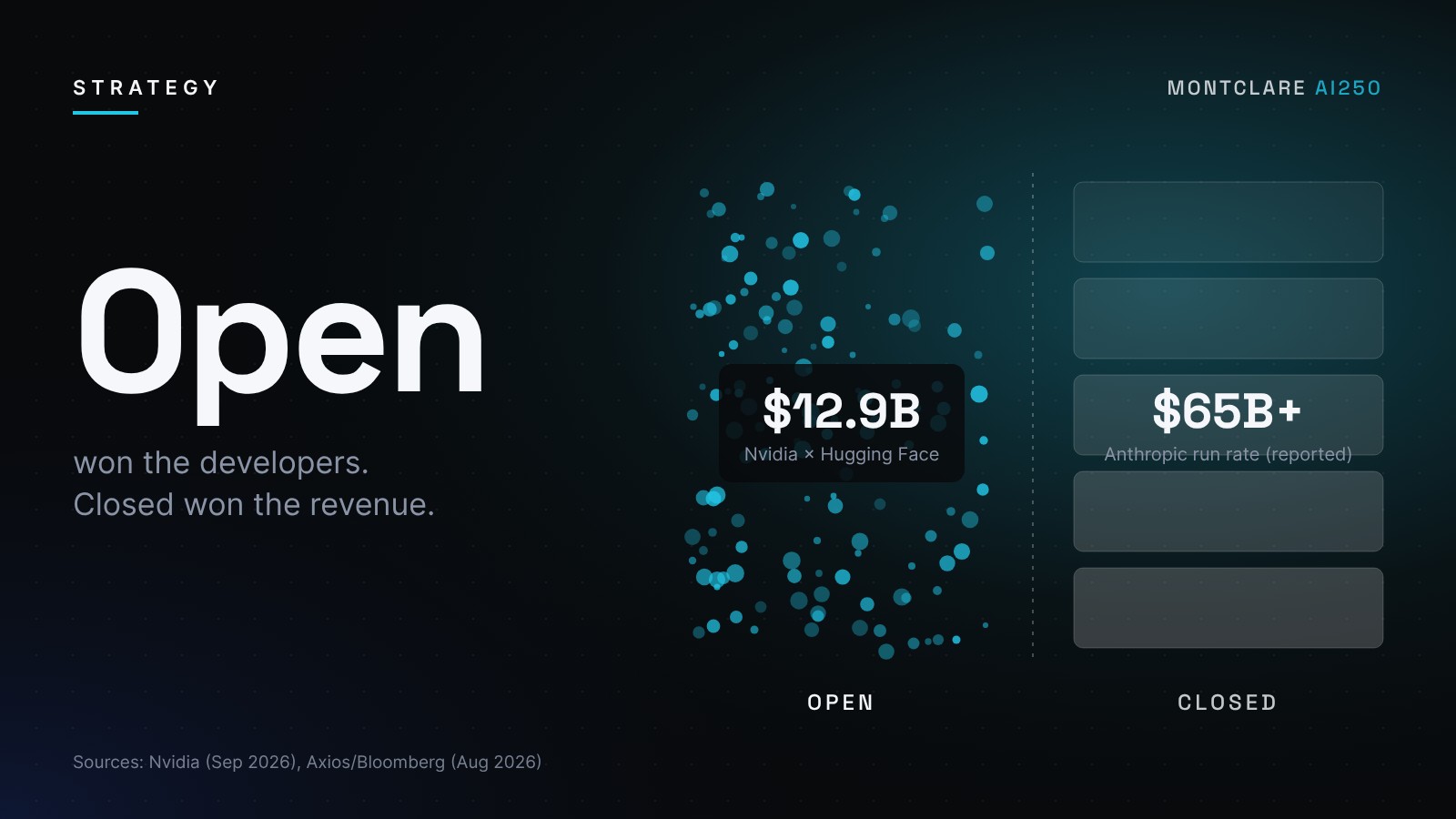
"Open won the ecosystem. Closed won the invoice. The companies in between are building the most interesting businesses."
In February we predicted that open-weight models would win the developer ecosystem while closed models captured high-value enterprise contracts. Eight months later, both halves of that prediction look stronger than when we wrote them.
All AI250 ranks, scores, and counts in this post are as of October 19, 2026. The live rankings update every night.
The Year of Open Weights
Open-weight models had a landmark year. DeepSeek released V4 in April. Moonshot AI shipped Kimi K3, which it claims is the largest open model in the world. Chinese labs in particular have made open releases a core strategy, and it shows in the AI250: DeepSeek is #4 and Moonshot is #15.
The biggest signal of all came in September, when Nvidia agreed to acquire Hugging Face (#6), the main hub for open models, for $12.9 billion. Nvidia pledged to keep the platform open and neutral. The world's most valuable chipmaker is betting that more open models mean more demand for its hardware.
The businesses around open weights are thriving too. Inference platforms that serve open models rank among the strongest companies in the index: Together AI (#8), Fireworks AI (#24), and Replicate (#66).
Why Closed Models Still Win Enterprise
And yet enterprise money is flowing overwhelmingly to closed models. Anthropic's run rate reportedly passed $65 billion at the end of July. OpenAI's reportedly reached $40 billion in August. Large enterprises buying AI at scale still want SLAs, indemnification, compliance documentation, and someone to call when something breaks. Running an open model on your own infrastructure means owning those problems yourself.
The work that's driving revenue (coding agents, enterprise workflows, long-running autonomous tasks) is also where frontier closed models have kept their edge. When a model is doing real work rather than answering questions, small differences in reliability translate into large differences in value.
The Hybrid Middle
The most interesting companies play both sides. Mistral (#21) releases open-weight models while selling enterprise deployments to more than 125 companies, and it just raised €3 billion. Cohere (#7) offers private deployment of its own models. Meta (#34) built the open-weight movement with Llama and turned it into a distribution strategy.
What the AI250 Shows
The dimension scores show the split clearly. We averaged ten open-weight labs in the index (including DeepSeek, Moonshot AI, Mistral, Meta, and Stability AI) against seven closed-model companies (including OpenAI, Anthropic, Google, and Perplexity). The open-weight group leads on Talent & Research (8.8 vs. 7.7), Product Depth (7.7 vs. 7.2), and Data & Model Moat (7.3 vs. 6.7). They publish, ship, and get cited. The closed group leads on Business Model & Revenue (6.0 vs. 4.3), Customer Adoption (6.5 vs. 4.2), and Investment Momentum (6.9 vs. 5.5). Neither profile alone puts a company at the top. OpenAI, at #1, is the only company in the top ten scoring at least 7 on all six.
Our bet for 2027: open models keep getting closer to the frontier, and margins for closed-model API access come under pressure. The winners will be the companies that own the customer relationship, regardless of whose weights sit underneath.
Compare open and closed model companies across all six Bluescore dimensions in the AI250.