
"Governance isn't a brake on AI adoption. In regulated industries, it's the on-ramp."
Earlier this year we published three separate pieces arguing that governance was becoming a competitive advantage in enterprise AI. The core thesis has held up. The regulatory calendar underneath it has changed significantly, so we've merged those posts into one current guide.
What Changed in 2026
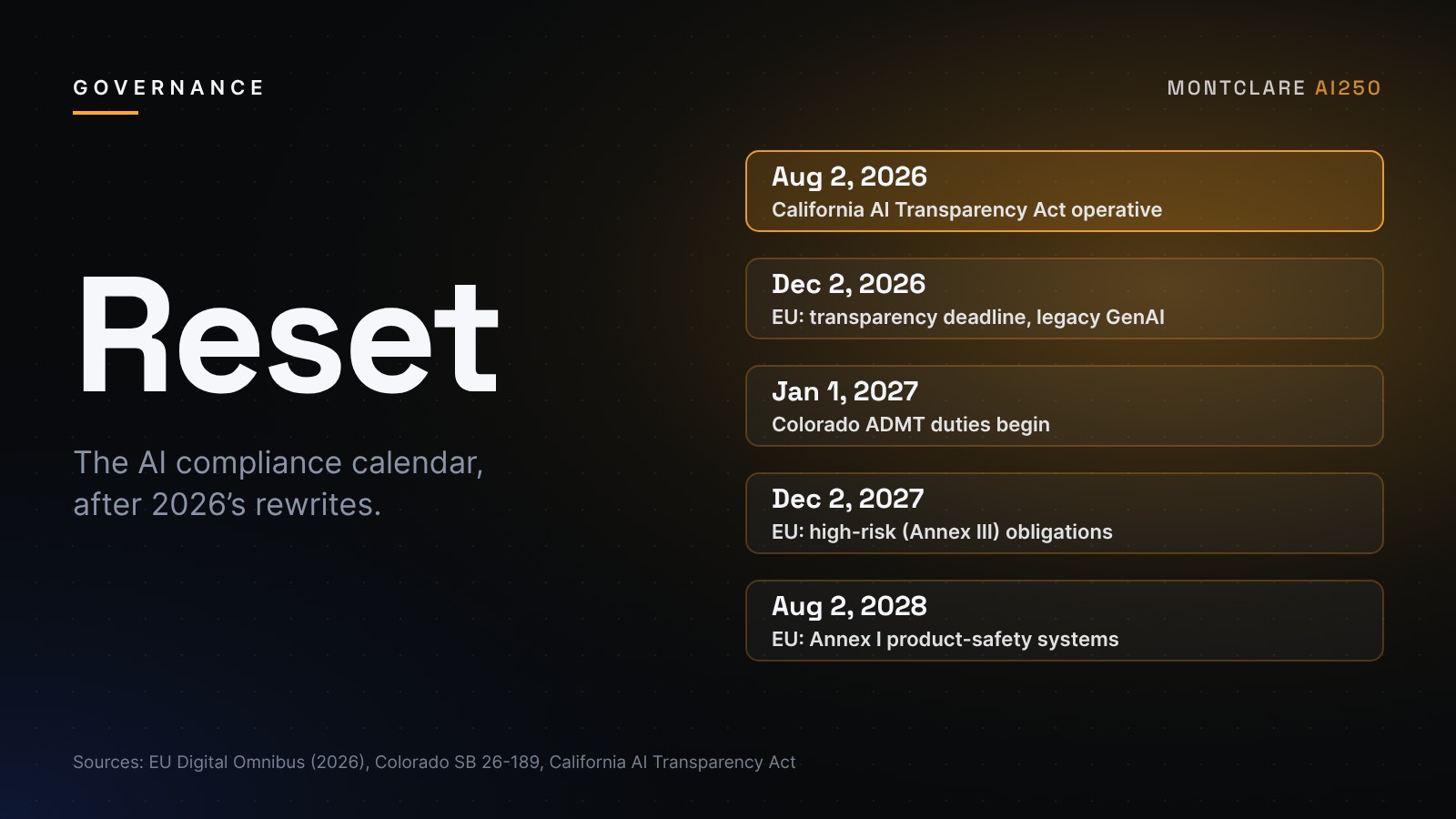
The EU AI Act was amended, not abandoned. The Digital Omnibus, finalized this summer, moved the obligations for high-risk AI systems listed in Annex III from August 2, 2026 to December 2, 2027. Systems covered by existing EU product-safety law (Annex I) now have until August 2, 2028. Generative AI providers whose systems were on the market before August 2026 have until December 2, 2026 to meet the synthetic-content transparency rules. The amendments also created a lighter-touch "small mid-cap" category for companies under 750 employees. More time, same destination.
Colorado rewrote its AI law. The original Colorado AI Act was repealed and re-enacted in May as a narrower framework focused on automated decision-making technology. Core developer and deployer duties now begin January 1, 2027, enforced by the state attorney general.
California is already live. Training-data transparency duties took effect in January 2026, and the California AI Transparency Act became operative on August 2, 2026, with further phases in 2027.
Federal preemption is still a proposal. A December 2025 executive order directed federal agencies to challenge burdensome state AI laws and recommend a national framework, but Congress hasn't enacted preemption. For now, multistate companies are still dealing with a patchwork.
Why Delays Don't Mean Relief
It's tempting to read the EU delay as permission to wait. Most enterprise legal teams aren't reading it that way. Procurement checklists, model risk frameworks, and audit expectations were written in 2025 and haven't been rolled back. Buyers are still asking vendors the same questions: Where does the data go? Can we log and explain outputs? Who is accountable when an agent takes an action?
The cloud parallel still applies. Organizations that built cloud governance early adopted new services faster, because legal and security already trusted the controls. The same thing is happening with AI agents now.
What the Leaders Are Doing
Deploying where the data lives. Cohere (#7 in the AI250 as of October 19, 2026) built its enterprise business around private and on-premises deployment. Mistral (#21) is selling sovereignty to European enterprises and governments, now more than 125 enterprise customers.
Building auditability into the product. Logging, traceability, and human-in-the-loop controls are becoming default features rather than add-ons, especially in agentic products that take actions rather than just generating text.
Bringing shadow AI into the light. Employees using personal AI accounts and unapproved tools remain one of the biggest unmanaged risks. The companies moving fastest make the approved path easier than the workaround.
Selling to government on its terms. Palantir (#26) shows how far "compliance-native" can scale in the most demanding procurement environment there is.
How the AI250 Approaches Governance
Bluescore methodology v4.0 defines a seventh dimension, Responsible AI, but doesn't score it yet. Earlier versions of our methodology used hand-assigned governance ratings, and this post previously cited them. We removed them because they weren't something we could compute consistently and defend across 250 companies. Until a reliable source exists, the Responsible AI weight is shared across the six scored dimensions rather than filled with a placeholder. What the index does track is our AI maturity classification, which flags the 12 companies in the AI250 we classify as "Washed": AI shows up mostly in marketing, not the product. The methodology is also designed in line with the NIST AI Risk Management Framework.
Explore the AI250 to see how each company is classified.