
"Follow the averages and you'll see where the signal is strongest. Follow the gaps and you'll see where the story is ahead of the data."
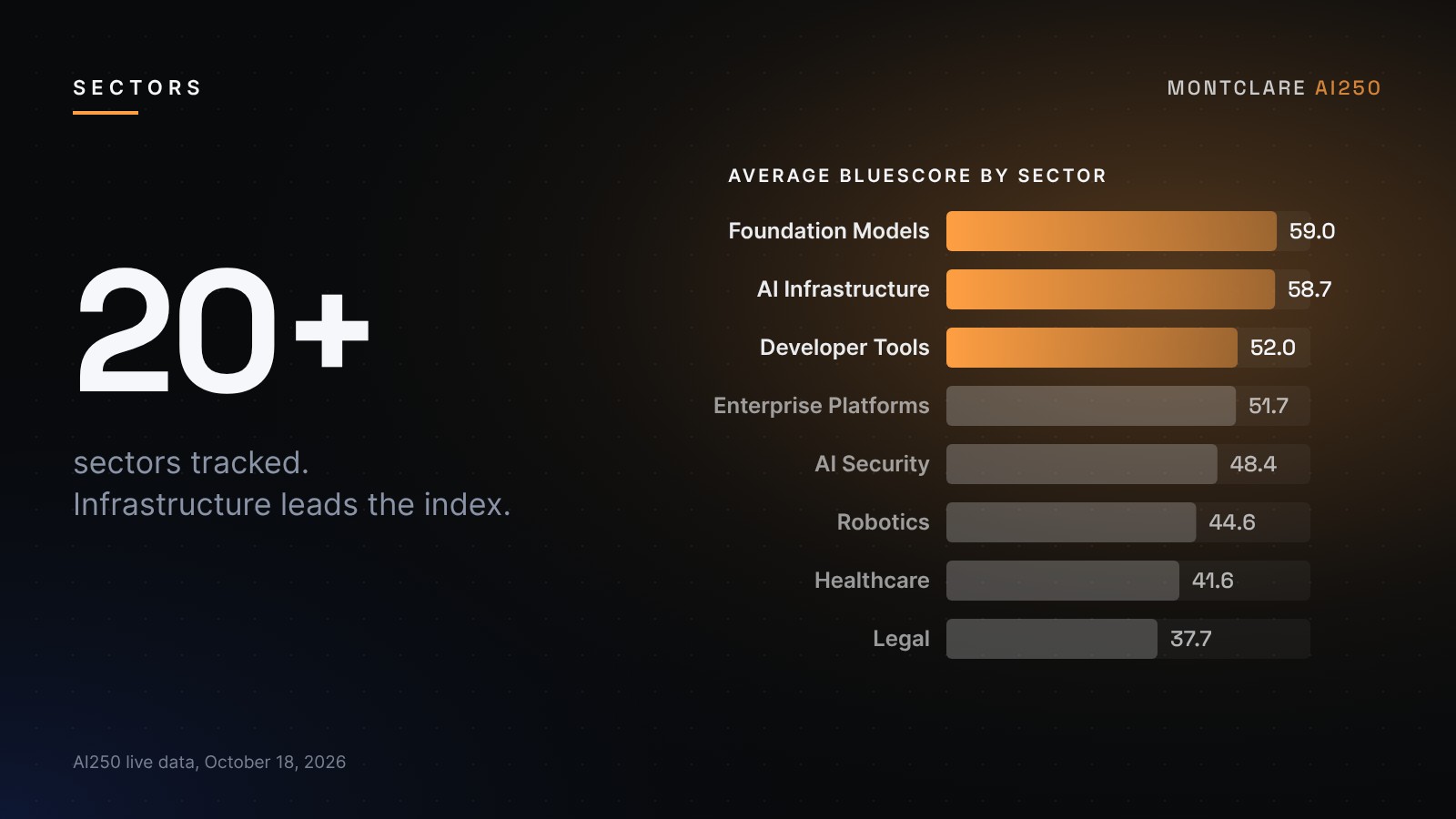
The AI250 classifies each company into one of 21 sectors. Comparing them shows where the strongest signals sit, and where capital and attention are running ahead of what the public data can confirm.
All AI250 ranks, scores, and counts in this post are as of October 19, 2026. The live rankings update every night.
Infrastructure Is the Center of Gravity
AI Infrastructure is the largest sector in the index, with 37 companies and an average Bluescore of 58.9. It also includes four of the top ten: Cerebras Systems (#3), Hugging Face (#6), Together AI (#8), and Scale AI (#9). The demand behind it is enormous. Nvidia's data center revenue hit $89 billion last quarter, up 117% year over year, and hyperscalers are on track to spend roughly $750 billion on capex this year.
Infrastructure is also where the industry is consolidating. Nvidia agreed in September to acquire Hugging Face for $12.9 billion, and Databricks (#13) raised $5 billion in Q3. Inference platforms rank near the top: Together AI (#8) and Fireworks AI (#24) both sit inside the top 25.
Foundation Models: Crowded at the Top
Foundation Models (33 companies, average 59.3) has the highest average Bluescore of any large sector, and it's where competition is fiercest. OpenAI (#1), DeepSeek (#4), Anthropic (#5), and Cohere (#7) lead, with Chinese and open-weight labs pressing hard from below. The sector is maturing in a familiar way: the winners are increasingly defined by distribution and enterprise relationships, not just model quality.
Developer Tools: The Quiet Outperformer
Developer Tools has only 12 companies but posts an average of 52.5, above AI Platforms (51.8). Replit (#61), Lovable (#70), Poolside (#75), LangChain (#82), and Braintrust (#85) lead. Coding is the most proven commercial use case for AI right now, and it's driving a large share of frontier-lab revenue. The tooling around it is benefiting.
Vertical AI: Big Rounds, Thinner Signals
This is the most interesting gap in the index. Vertical AI sectors (healthcare, legal, finance, HR, real estate, and more) average Bluescores between the mid 30s and low 40s, well below the horizontal sectors. Yet they're attracting some of the year's largest rounds. Harvey raised $550 million at a $15.6 billion valuation in September with more than $400 million in ARR, but it ranks #153 in the AI250.
That isn't a contradiction. Vertical AI companies sell into specialized markets with less press coverage, fewer open-source repositories, and fewer research papers, which are the signals Bluescore can observe publicly. Their traction shows up in customer contracts that are rarely disclosed. Harvey is a clear example: it scores 7.0 on Investment Momentum but 2.3 on Talent & Research. When a vertical company's investment signal runs far ahead of its build and research signals, it's worth asking whether the gap is a data blind spot or a valuation that's run ahead of the business.
In healthcare (19 companies), the leaders are Chai Discovery (#42), Tempus AI (#81), Insilico Medicine (#89), and Qure.ai (#108). AI-native drug discovery is drawing serious capital and producing measurable research output.
Physical AI: From Demos to Deployments
Robotics (11 companies, average 44.3) is led by Apptronik (#87), Skydio (#93), Agility Robotics (#96), and Skild AI (#102). Physical Intelligence (#40) is classified with infrastructure because it builds general-purpose robot foundation models. Defense AI is led by Palantir (#26) and Helsing (#95), which raised $1.8 billion in Q3. Physical AI is absorbing billions, and its public signals are starting to follow.
Browse the AI250 by sector to see which categories are accelerating.