
"For three years the best AI companies were private by choice. In 2026, they started choosing the public markets."
In May we framed the AI market as two separate games: liquid public stocks on one side and asymmetric private bets on the other. That line is now blurring fast. This post replaces both that piece and our earlier "best AI companies to invest in" list. A ranking built on public signals isn't a stock-picking tool, and we'd rather show you how the market is structurally changing.
All AI250 ranks, scores, and counts in this post are as of October 19, 2026. The live rankings update every night.
The Class of 2026
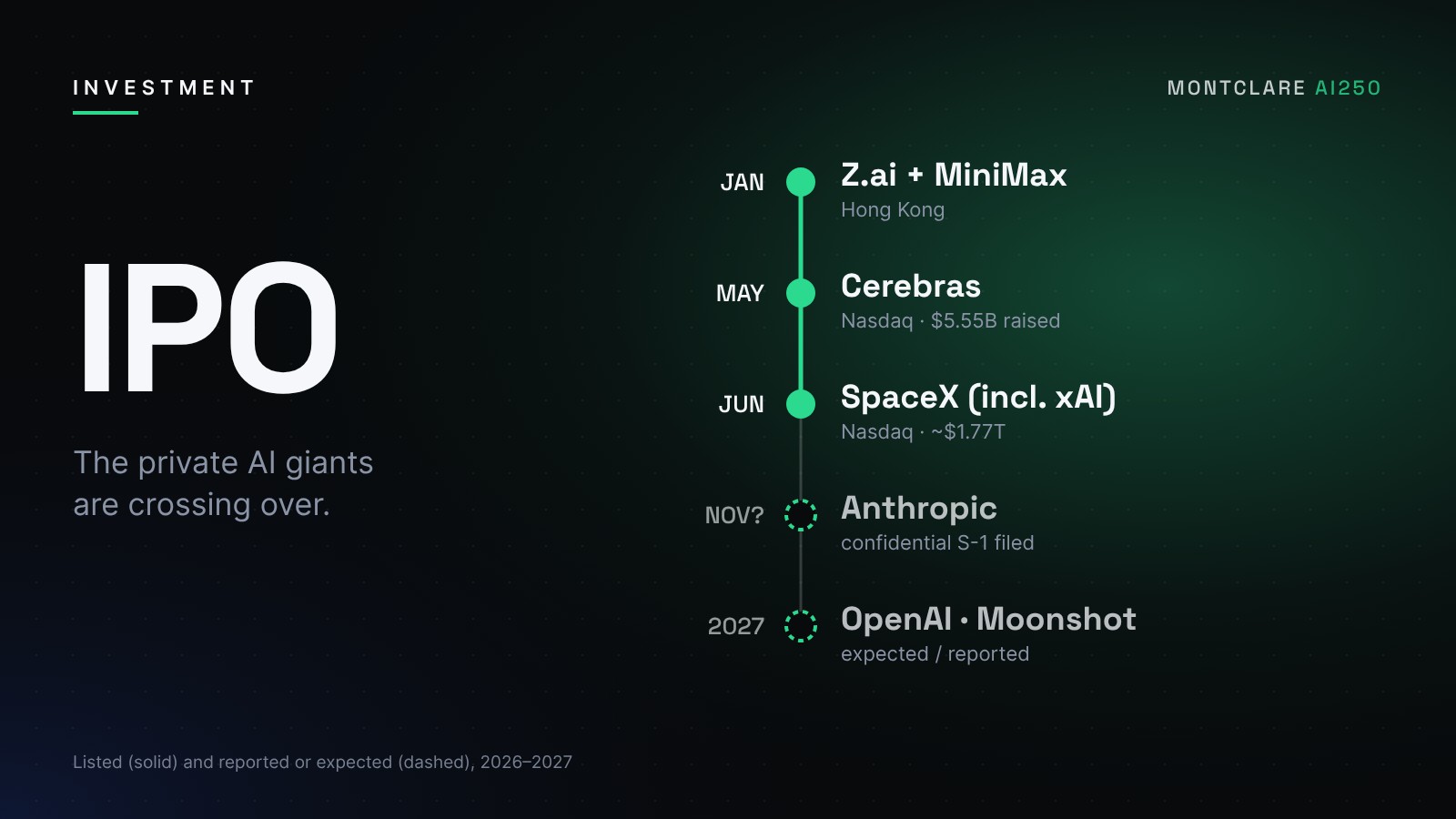
Cerebras Systems priced its IPO at $185 per share in May, raising about $5.55 billion in one of the year's biggest tech debuts. The stock roughly doubled on its first day. It's now #3 in the AI250.
SpaceX listed on Nasdaq in June at about $1.77 trillion, four months after absorbing xAI. For the first time, public investors can own a frontier model lab, albeit inside a rocket company.
Z.ai (Zhipu) and MiniMax both listed in Hong Kong in January, each at roughly $6.5 billion. Z.ai is #11 in the AI250.
Anthropic has confidentially submitted a draft S-1. Bloomberg reports a listing could come in mid-November, though nothing is public on EDGAR yet.
Moonshot AI, maker of the Kimi models, is reportedly preparing a confidential Hong Kong filing at a valuation of up to $50 billion for as early as Q1 2027. A reported $700 million shareholder dispute is still unresolved.
OpenAI has said no IPO in 2026 and is reportedly raising a pre-IPO bridge at around $1.4 trillion ahead of a listing expected in 2027.
What the AI250 Data Says About Public vs. Private
As of October 19, 2026, the 39 public companies in the index average a Bluescore of 58.3, while the 211 private companies average 46.6. That gap is partly structural. Public companies disclose more, so more of their signals are read from filings rather than estimated, and a signal we can't find takes the population median, which pulls thinly covered companies toward the middle. Sparse data shouldn't be confused with weak performance.
The more interesting pattern is what happens around a listing. An IPO turns a private company's thinnest signals (revenue, headcount, margins) into audited disclosures overnight. Cerebras now sits at #3, with scores of 9.0 on Talent & Research and 9.3 on Data & Model Moat. Expect the picture to sharpen in the same way for any frontier lab that files publicly.
The Public Side: Priced for a Lot
Nvidia reported $96.2 billion in revenue for the quarter ended July 26, up 106% year over year, and guided to about $108 billion next quarter. The public AI trade isn't fading. But the market is already pricing in years of growth, and hyperscaler capex is running ahead of AI revenue by a wide margin. Public AI exposure is now as much a bet on the build-out's financing as on the technology.
The Private Side: Where the Signal Still Hides
Some of the strongest signals in the AI250 come from private companies the market wasn't watching closely a year ago: Together AI (#8), Fireworks AI (#24), and Lightning AI (#28) all sit inside the top 30. Private markets remain where signal moves before price does. The trade-off is less disclosure, which is why every profile shows the six dimension scores behind the number.
How to Use This
Bluescore is not a recommendation to buy or sell anything, and nothing here is investment advice. What it offers is a consistent way to compare public and private AI companies on the same six dimensions, so you can see when a narrative is running ahead of the data, or when the data is running ahead of the narrative.
Compare public and private AI companies side by side in the AI250.