
"AI isn't really a standalone investment theme anymore." (Carolina Oliveira, KPMG)
In February we asked whether AI valuations were defying gravity. By October the question had changed from whether they'd reach a trillion dollars to how many companies will. OpenAI is reportedly in talks at about $1.4 trillion. Anthropic raised at a reported $965 billion. SpaceX, which now includes xAI, went public at roughly $1.77 trillion. This post replaces our earlier funding report and our "Race to $1 Trillion" piece with a single view of where AI capital stands now.
The Numbers
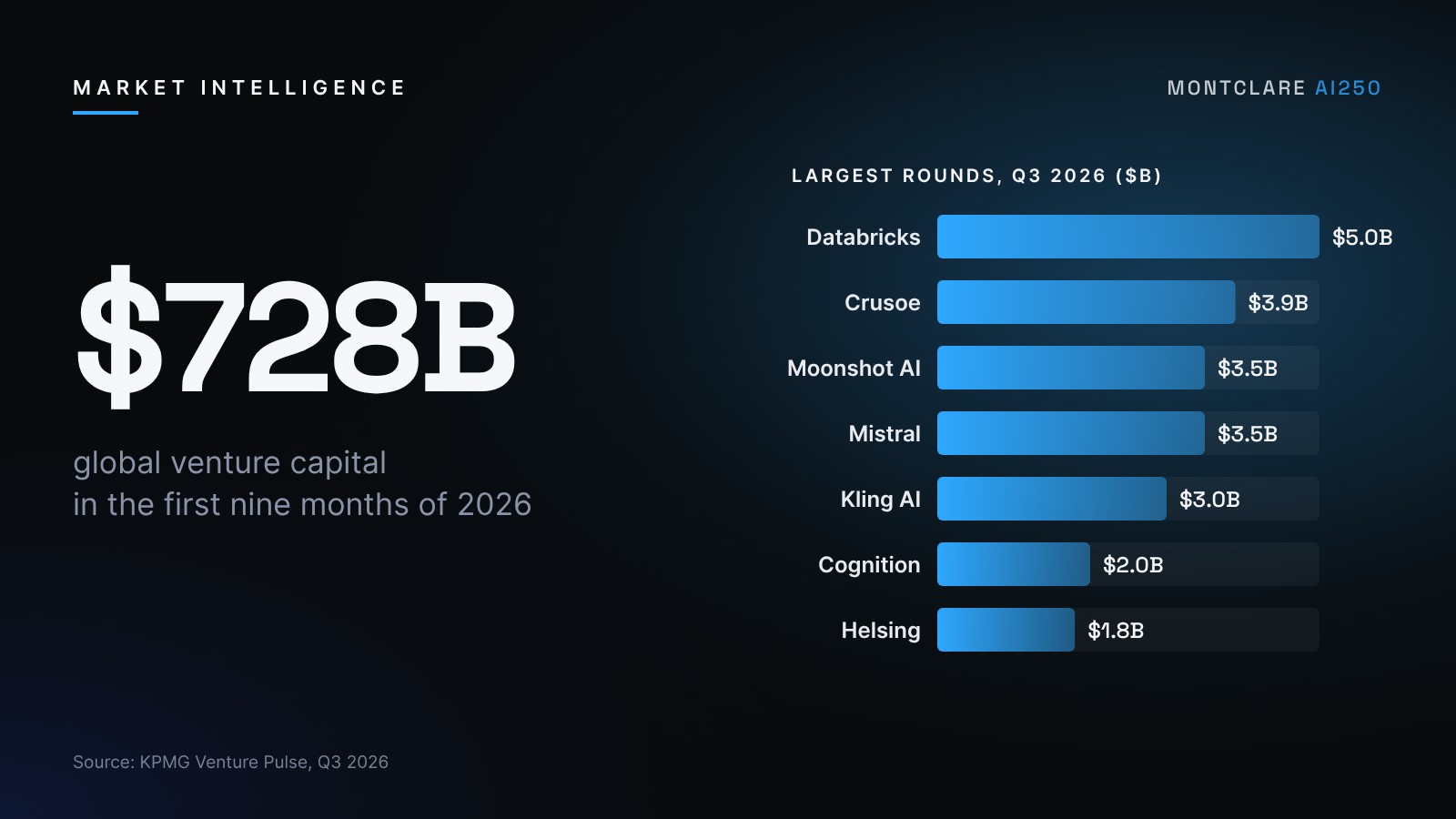
Global venture investment hit $170.9 billion across 8,341 deals in Q3 2026, according to KPMG's Venture Pulse, bringing the year-to-date total to $728.3 billion. Fourteen rounds exceeded $1.5 billion, nine of them in the US. KPMG's description of the market is "quite bifurcated": more money, concentrated in fewer and larger deals.
The biggest rounds of the quarter were overwhelmingly AI and AI infrastructure: Databricks ($5 billion), Crusoe ($3.9 billion), Moonshot AI ($3.5 billion), Mistral ($3.5 billion), Kling AI ($3 billion), Cognition ($2 billion), and Helsing ($1.8 billion).
The Frontier Labs Are in a League of Their Own
The mega-rounds at the top distort every average. OpenAI raised $122 billion at an $852 billion valuation in March. Anthropic raised in February at $380 billion and again in May at a reported $965 billion. These rounds are less like venture capital and more like infrastructure finance: the money is going straight into compute.
Below the Frontier: Vertical AI Gets Paid
Some of the more instructive rounds happened one layer down. Harvey raised $550 million at a $15.6 billion valuation in September, up from $11 billion in March. It reports more than $400 million in ARR and more than 3,000 customers. That's what investors are rewarding now: domain-specific products with real revenue, not general-purpose demos.
Physical AI Is Absorbing Capital
The other clear pattern is that money is flowing into atoms, not just software. Data centers (Crusoe, plus Nscale's $3.36 billion convertible note), defense (Helsing, Quantum Systems), and chips (Cerebras' $5.55 billion IPO) are all drawing billions. AI is pulling capital into energy, real estate, and hardware at a scale that makes it look like an industrial build-out.
The Bubble Question
It would be dishonest to publish a funding report without addressing it. MIT Technology Review estimates hyperscalers will spend about $750 billion on capex in 2026 and more than $1 trillion in 2027, against total AI revenues of roughly $150–200 billion this year. Morgan Stanley estimates more than half of hyperscaler spending through 2028 will be financed externally. Alphabet posted its first free-cash-flow deficit since its IPO.
The counter-argument is revenue that's real and compounding. Nvidia's data center revenue hit $89 billion last quarter, up 117% year over year. Anthropic's run rate reportedly grew about sevenfold in seven months. The question isn't whether AI is valuable. It's whether today's prices assume too much of the value arrives too soon.
What the AI250 Adds
Capital is one input to Bluescore, not the score. Investment Momentum (total funding, the last round, and recent stock performance for public companies) is one of six dimensions and carries 10% of the weight. Funding alone can't carry a company to the top of the AI250. It has to be matched by revenue, product depth, technical moat, talent, and customer adoption. When a company's Investment Momentum score runs far ahead of the rest of its profile, the gap is visible in its dimension breakdown. That's the early warning most funding headlines miss.
Track investment and build signals side by side for every company in the AI250.